3. Requirements
3.1. External Interface Requirements
Name |
Type |
Width |
Description |
|---|---|---|---|
clk_i |
I |
1 |
Clock input. |
rst_i |
I |
1 |
Hardware reset. |
Name |
Type |
Width |
Description |
|---|---|---|---|
wb_adr_i |
I |
32 |
The address output array is used to pass binary address. |
wb_dat_i |
I |
32 |
The data input array is used to pass binary data. |
wb_dat_o |
O |
32 |
The data output array is used to pass binary data. |
wb_sel_i |
I |
4 |
The select output array indicates where valid data is expected on the wb_dat_i signal array during READ cycles, and where it is placed on the wb_dat_o signal array during WRITE cycles. Each individual select signal correlates to one of four active bytes on the 32-bit data port. |
wb_we_i |
I |
1 |
The write enable output indicates whether the current local bus cycle is a READ or WRITE cycle. This signal is negated during READ cycles and is asserted during WRITE cycles. |
wb_stb_i |
I |
1 |
The strobe output indicates a valid data transfer cycle. It is used to qualify various other signals on the interface. |
wb_ack_o |
O |
1 |
The acknowledge input, when asserted, indicates the normal termination of a bus cycle. |
wb_cyc_i |
I |
1 |
The cycle output, when asserted, indicates that a valid bus cycle is in progress. This signal is asserted for the duration of all bus cycles. |
wb_stall_o |
O |
1 |
The stall input indicates that current slave is not able to accept the transfer in the transaction queue. |
3.2. Functional Requirements
3.2.1. Memory interface
3.2.1.1. Wishbone protocol
The following requirements are extracted from the Wishbone specification.
| ID | F_WISHBONE_DATASHEET_01 |
| Description | The memory interface shall comply with the Wishbone Datasheet provided in section 2.1. |
| Derived from |
| ID | F_WISHBONE_RESET_01 |
| Description | The memory interface shall initialize itself at the rising edge of clk_i following the assertion of rst_i. |
| Derived from |
| ID | F_WISHBONE_RESET_02 |
| Description | The memory interface shall stay in the initialization state until the rising edge of clk_i following the deassertion of rst_i. |
| Derived from |
| ID | F_WISHBONE_TRANSFER_CYCLE_01 |
| Description | The memory interface shall only respond to transfer cycles when wb_cyc_i is asserted. |
| Derived from |
| ID | F_WISHBONE_HANDSHAKE_01 |
| Description | The memory interface shall assert the wb_ack_o signal in response to the logical AND of wb_cyc_i and wb_stb_i. |
| Derived from |
| ID | F_WISHBONE_READ_CYCLE_01 |
| Description | The memory interface shall conform to the READ cycle detailed in the figure below. |
| Derived from |
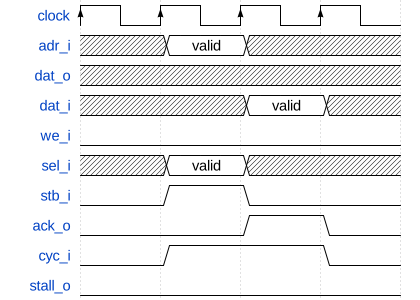
Timing diagram of the wishbone read cycle
| ID | F_WISHBONE_WRITE_CYCLE_01 |
| Description | The memory interface shall conform to the WRITE cycle detailed in figure below. |
| Derived from |
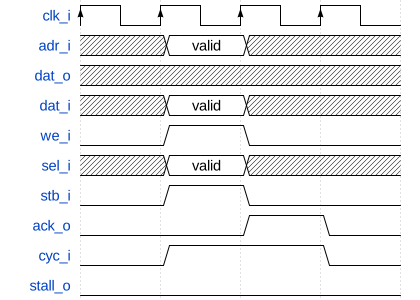
Timing diagram of the wishbone write cycle
| ID | F_WISHBONE_TIMING_01 |
| Description | The clock input clk_i shall coordinate all activites for the internal logic within the memory interface. All output signals of the memory interface shall be registered at the rising edge of clk_i. All input signals of the memory interface shall be stable before the rising edge of clk_i. |
| Rationale | As long as the memory interface is designed within the clock domain of clk_i, the requirement will be satisfied by using the place and route tool. |
| Derived from |
3.2.1.2. Memory-mapped registers
| ID | F_REGISTERS_01 |
| Description | The following registers shall be implemented and accessible through the wishbone memory interface. |
| Derived from |
|
Address Offset |
Register name |
Width (in bits) |
Access |
Reset value |
Section/page |
|---|---|---|---|---|---|
0000_0000h |
Status register (SPI_SR) |
32 |
R |
0000_0000h |
|
0000_0004h |
Control register (SPI_CR) |
32 |
R/W |
0000_0000h |
|
0000_0008h |
Receive Data register (SPI_RXDR) |
32 |
R |
0000_0000h |
|
0000_000Ch |
Transmit Data register (SPI_TXDR) |
32 |
W |
0000_0000h |
3.2.1.2.1. Status register (SPI_SR)
Position |
Field |
Description |
|---|---|---|
31-1 |
Reserved |
This field is reserved. This read-only field is reserved and always has the value 0. |
0 |
TXE |
Transmit register Empty 0 The transmit register is full (being sent) 1 The transmit register is empty |
3.2.1.2.2. Control register (SPI_CR)
SPI_CR contains the control for selecting the SPI frequency and controlling the chip select.
Position |
Field |
Description |
|---|---|---|
31-16 |
Prescaler |
SPI frequency selector The specified SPI frequency is f_spi = (f_sys / (2 * prescaler)). |
15-1 |
reserved |
This field is reserved. This read-only field is reserved and always has the value 0. |
0 |
CS |
Active-high Chip select 0 Chip-select disabled 1 Chip-select enabled |
3.2.1.2.3. Receive Data register (SPI_RXDR)
Position |
Field |
Description |
|---|---|---|
31-8 |
reserved |
This field is reserved. This read-only field is reserved and always has the value 0. |
7-0 |
RXD |
Receive Data The received data is written to this field. The field is cleared by hardware after being read. |
3.2.1.2.4. Transmit Data register (SPI_TXDR)
Position |
Field |
Description |
|---|---|---|
31-8 |
reserved |
This field is reserved. |
7-0 |
TXD |
Transmit Data Data written to this field is sent through the serial link. The TXE field of the SPI_SR shall be sample before writing again to this field to prevent data loss. |
3.3. Non-functional Requirements
N/A